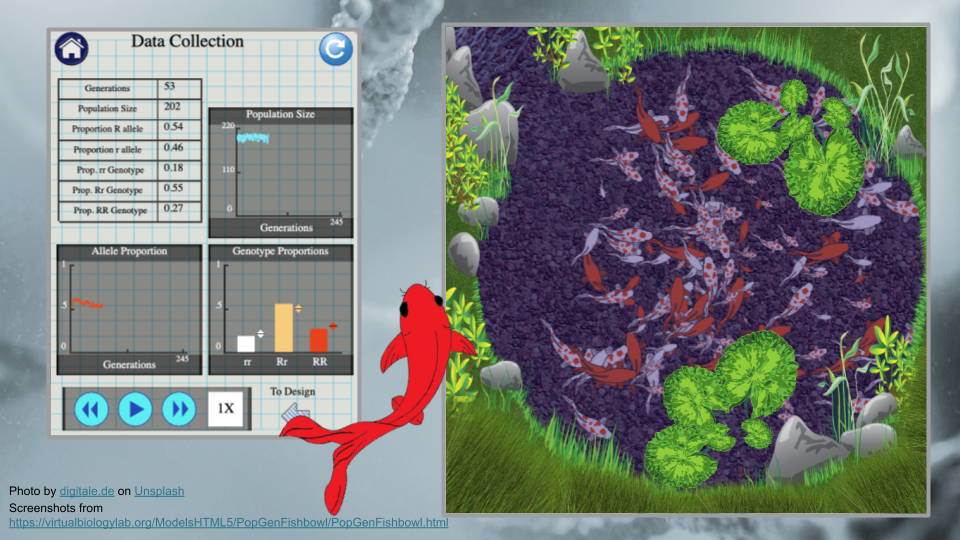
Population Genetics: Fish Pond Simulator
Overview
This module uses the PopGen Fishbowl simulator to model natural selection and genetic drift, as well as explore whether populations are at Hardy-Weinberg equilibrium.
This activity was adapted from an original activity by Rosa Alcazar and Stephanie Coffman of Clovis Community College. Introductory Information are derivatives of the following works:
- “Darwin, Evolution and Natural Selection” by Khan Academy licensed CC BY-NC-SA 4.0.
- “Allele Frequency and the Gene Pool” by Khan Academy licensed CC BY-NC-SA 4.0.
Duration: 1 - 2 hours
Evaluation
GEMs is an NIH-funded program. Part of our mission is understanding the impact of our materials. Please take the time to review our program as an instructor after this activity. We also appreciate you distributing our survey to students before and after they participate in GEMs content.
TipHelp Us Improve!
You can view our IRB approval here. Feel free to contact the GEMs team with any questions (gems at fredhutch dot org).
Learning Objectives
Determine if a population is in Hardy-Weinberg equilibrium
Compare and contrast natural selection and genetic drift
Predict outcomes of interactions between genotypes and environmental pressures
Prerequisites
Students will benefit from some awareness of basic evolutionary theory, particularly Mendelian inheritance, as well as the concepts of phenotypes, genotypes, and the relationship between the two. Students should also understand the concepts of genetic drift and natural selection.
Student Materials
You can use this module in several formats. Feel free to adapt to your needs!
Students will need a device that accesses the internet.
WarningThis content contains URLs
We suggest confirming links are still active prior to running this activity.
Link: PopGen Fishbowl simulator.
Instructor Materials
An answer key is available here. Please message Ava Hoffman (ahoffma2 at fredhutch dot org) to get access.
This answer key also provides guidance on areas of the activity that students may find tricky.
Scientific Topics
Students will gain exposure to the following:
Population genetics (microevolution as changes in allele frequencies over generations)
Alleles, genotypes, and phenotypes (and how genotype/phenotype frequencies relate to allele frequencies)
Hardy–Weinberg equilibrium (HWE) as a baseline model for a non-evolving population
Genetic drift (random changes in allele frequencies due to chance, especially in small populations)
Natural selection (environment-dependent differences in reproductive fitness)
Migration (gene flow) and how it can alter allele frequencies (modeled as a parameter in the simulator)
Environmental change and fitness landscapes (how reversing which genotype is favored changes allele trajectories)
Statistical hypothesis testing using chi-square tests to test equilibrium vs. deviation from expected frequencies
Random mating vs. assortative mating (assortative mating parameter affects mating patterns and outcomes)
Fixation of an allele (when an allele reaches frequency 1 in the population)
Outline
- Activity 1: Hardy-Weinberg Equilibrium
- Activity 2: Drift
- Activity 3: Natural Selection and Environmental Pressures
- Bonus Activity