DNA Barcoding and Forensics
This activity explores forensic uses of DNA barcoding and DNA reference datasets. You will work with data based on real forensic investigations in order to identify the species of a sample based on a small fragment of DNA.
Before doing this activity, make sure to read about these case files here!
Part 1: What organism do your samples come from?
In the herbal medicine case study, the students ordered products from online retailers and then amplified the DNA for DNA barcoding. One product they tested is Devil’s Claw (also called grapple plant or wood spider), a member of the sesame plant family. This particular herb is native to southern Africa and is commonly taken as an anti-inflammatory, especially for low back pain. According to the packaging, this product should contain the species Harpagophytum procumbens.
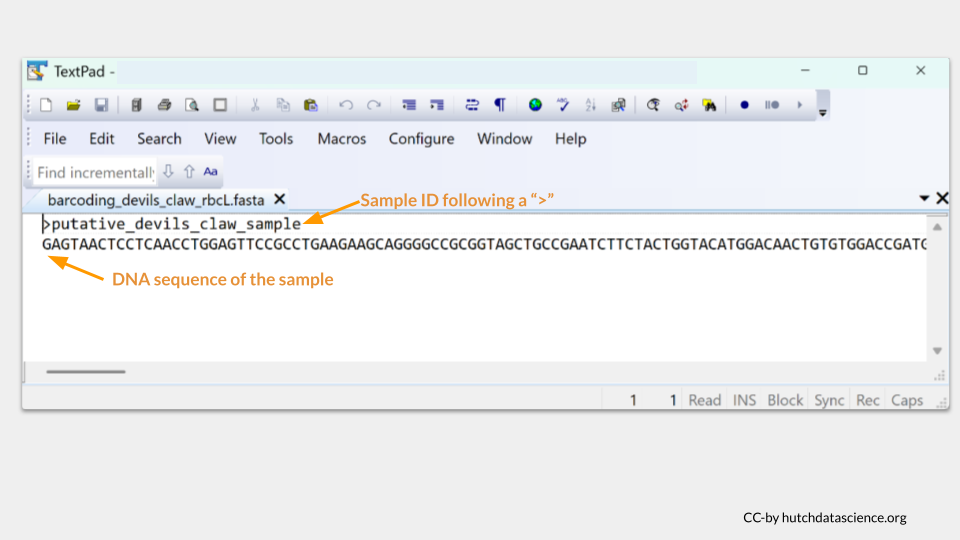
Let’s explore the genomic sequence from the plant gene rbcL. This sequence is stored as a fasta file (pronounced “fast A”). This is a standard bioinformatics data file that stores information on two lines: a header line beginning with a greater-than symbol (“>”), as well as a second line with the raw sequence data.
Tip
The rbcL (Ribulose-1,5-bisphosphate carboxylase/oxygenase large subunit) gene is located in the chloroplast genome and encodes a subunit of the Rubisco enzyme. You might remember from previous lessons on photosynthesis that the Rubisco enzyme plays a big part in fixing the carbon from carbon dioxide into glucose. Because it plays such an important role in a vital plant process, it’s highly conserved and can be found in almost all plants!
Get the data at https://genomicseducation.org/data/barcoding_devils_claw_rbcL.fasta.
Next, open the Barcode ID website https://id.boldsystems.org/. This is an open database that you can use to search for a species match to your DNA barcode. The Barcode ID project was originally created as a searchable database for all animal species, but has expanded to other organisms like fungi and plants.
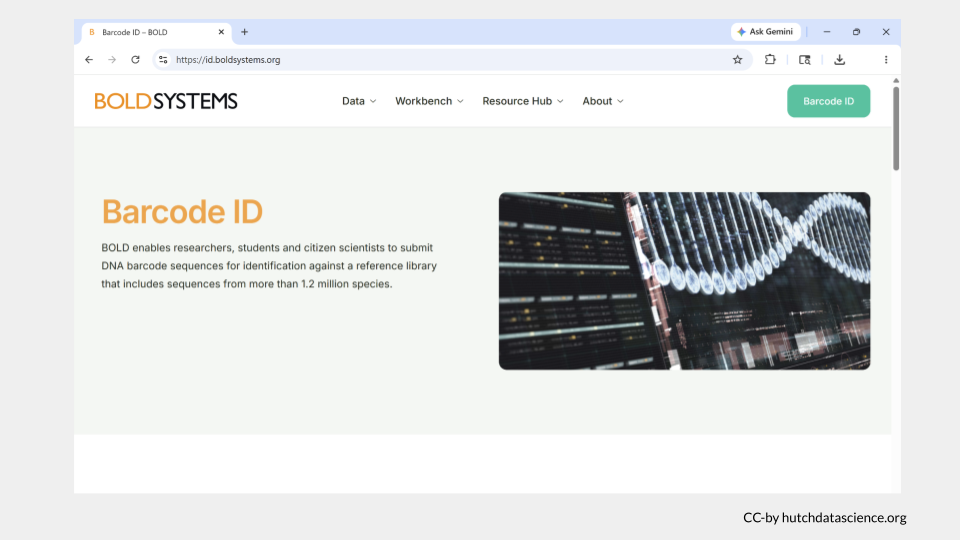
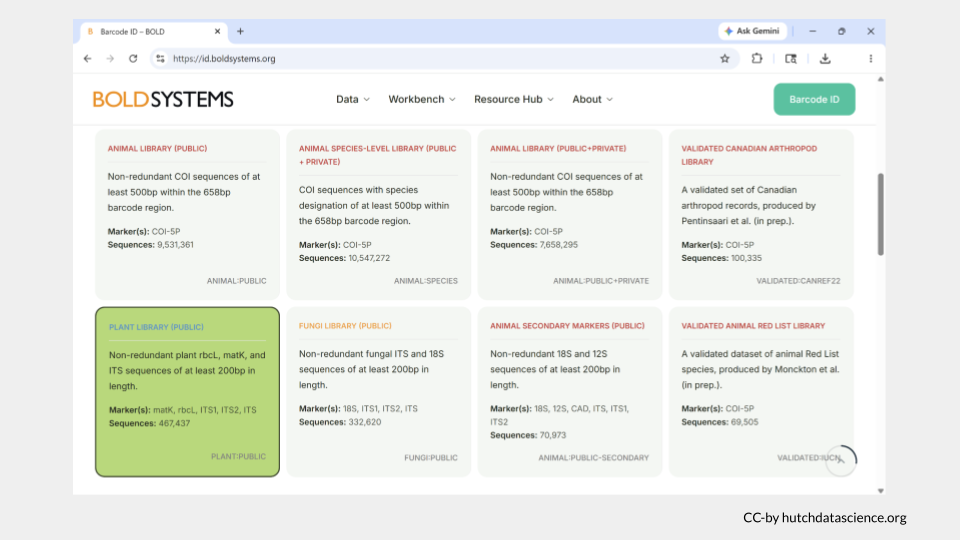
Scroll down to the images of all the possible sequence reference libraries that can be searched using BOLD. For the herbal medicine example, we’re interested in identifying plants. Click on the box for the PLANT LIBRARY (PUBLIC). This particular database includes reference sequences from the gene regions rbcL, matk, and ITS.
Continue scrolling down and make sure that “Rapid Species Search” is selected. This is the quickest option and will only return IDs for sequences that are at least 94% the same as the sample.
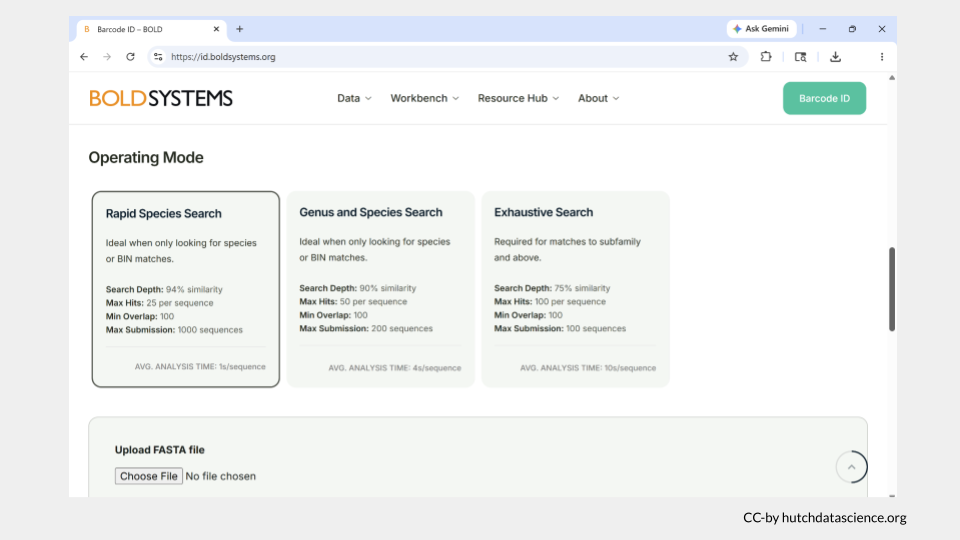
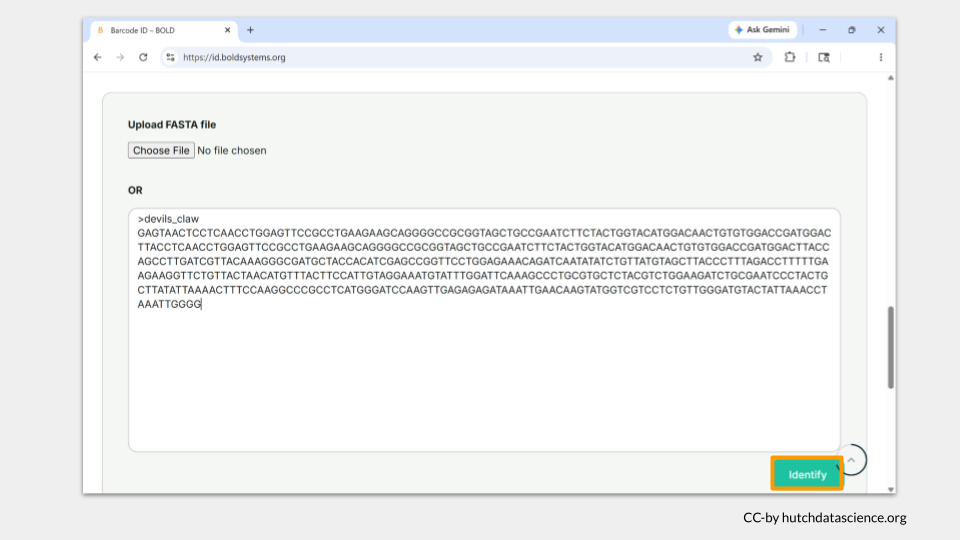
Scroll down until you reach a gray box titled Upload FASTA file. This is where you actually submit your sample sequence. For this example, you will submit a sequence from the rbcL barcode region for your putative devil’s claw sample.
Paste the sequence you downloaded earlier into the box. (Remember, you can download this file at https://genomicseducation.org/data/barcoding_devils_claw_rbcL.fasta.)
Once you have pasted the sequence, click Identify.
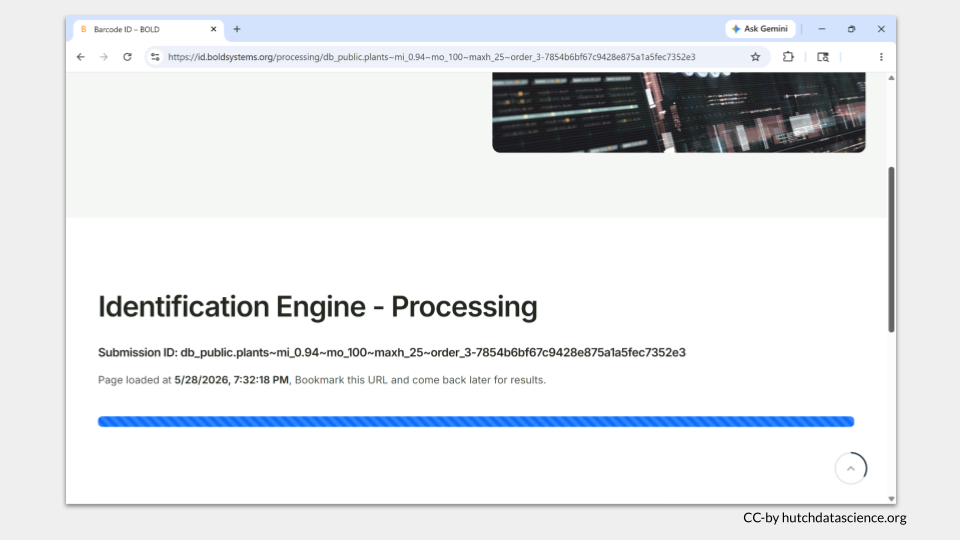
The browser will take you to a new page while your search is happening. It may take a minute or two for your search to complete, but keep the webpage open. When the search is complete, the status bar will turn green, but there will still be a lag before you see the results. Just be patient!
The Identification Engine - Result page takes a about a minute to fully load. The first section (Classification) will be empty - this is totally normal. Scroll down until you reach the Combined Hits section. The results table is organized with the “best” sequence matches listed first. Each row in the table will include the Query ID (the name of the sample in your fasta file), taxonomic information, and the ID%, or percent identity. This is the percentage of your sample (query) that exactly matches a reference sample in the database.
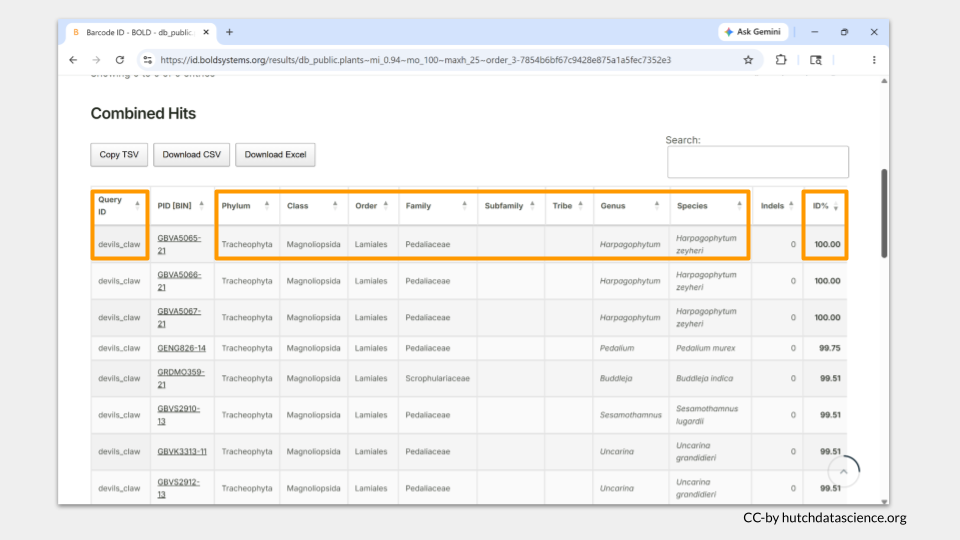
We can see that the top hit here is for the species Harpagophytum zeyheri, which is not the species we expected! The common name for this species is also devil’s claw. Despite sharing the same common name, Harpagophytum zeyheri and Harpagophytum procumbens are distinct (though related) species. Notice that there are three reference sequences with a 100% percent identity to our sample, and all three reference sequences are from Harpagophytum zeyheri.
TipPart 1: Herbal Medicine Investigation
Three additional herbal medicines the researchers tested were black cumin, goat’s head, and epazote. Following the devil’s claw example, use the BOLD website to identify these three samples, then answer the questions below.
- putative black cumin sample: https://genomicseducation.org/data/barcoding_black_cumin_rbcL.fasta
- putative goat’s head sample: https://genomicseducation.org/data/barcoding_goats_head_rbcL.fasta
- putative epazote sample: https://genomicseducation.org/data/barcoding_epazote_rbcL.fasta
TipPart 1: Suspected Parrot Smuggling
The accused smuggler claimed the eggs he was carrying were quail eggs. Following the devil’s claw example, use the BOLD website to identify these three unknown egg samples, then answer the questions below. Make sure to choose the ANIMAL LIBRARY (PUBLIC) database.
The sequences are from the COI (Cytochrome c oxidase subunit I) gene, a mitochondrial gene that is popular for barcoding work among animals, as it shows high variability between many species but low variability among individuals within a species.
- putative quail egg #1: https://genomicseducation.org/data/barcoding_bird1_COI.fasta
- putative quail egg #2: https://genomicseducation.org/data/barcoding_bird2_COI.fasta
- putative egg #3: https://genomicseducation.org/data/barcoding_bird3_COI.fasta
NoteCheck Your Knowledge
In our example, what are some reasons for the mismatch between the expected species (Harpagophytum procumbens) and the species identity suggested by BOLD (Harpagophytum zeyheri)?
Answer the following questions based on your case file samples. According to your BOLD search, what is the species identity of the each sample in the case study you chose? What are the common names of these species?
What is the percent identity value for the top result of each search?
Do these species identities match the putative identity of each sample?
Part 2: Verify sample identification
Researchers will frequently sequence two different barcoding genes from a sample to increase their confidence in their species identification. The BOLD database, while quite useful, mostly focuses on curating reference data for a limited number of barcoding genes. Luckily, we can search other databases to check the species identity based on genes (or reference samples) not found in the BOLD database.
For this section, you will use sequence from the ITS2 region.
Tip
ITS2 (Internal Transcribed Spacer 2) is a a short, highly variable segment of nuclear ribosomal DNA located between the 5.8S and 28S rRNA genes. ITS2 is not a gene, but this region of DNA can be found across animals, plants, and fungi.
One of the most extensive genomic reference databases in the world is GenBank, which is maintained by the National Institutes of Health. We will use a tool called the Basic Local Alignment Search Tool (BLAST) to match the sample sequences to the reference database.
First, open BLAST.
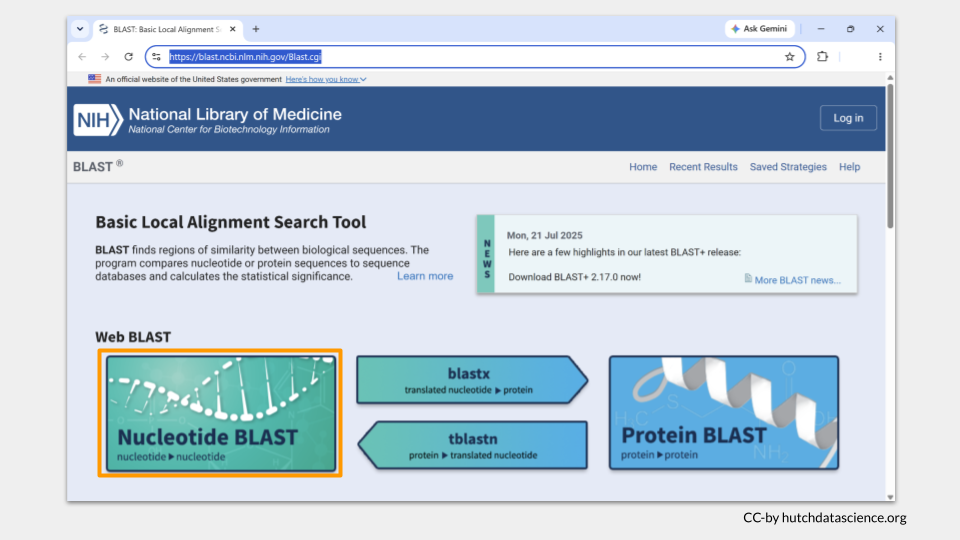
Click on the “Nucleotide BLAST” image. This is the type of search you do when you have a nucleotide sequence and you want to compare it to other nucleotide sequences.
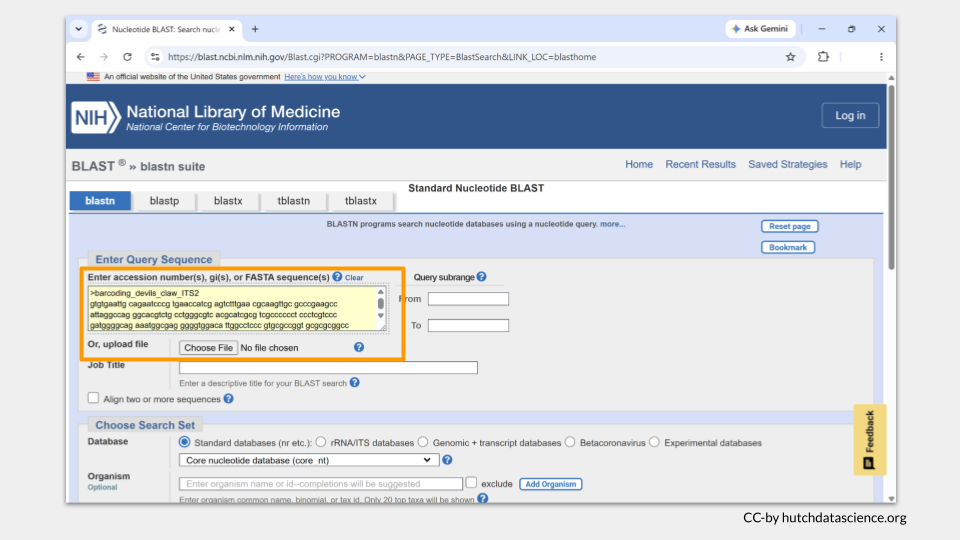
Download the data at https://genomicseducation.org/data/barcoding_devils_claw_ITS2.fasta, then paste the sequence into the box.
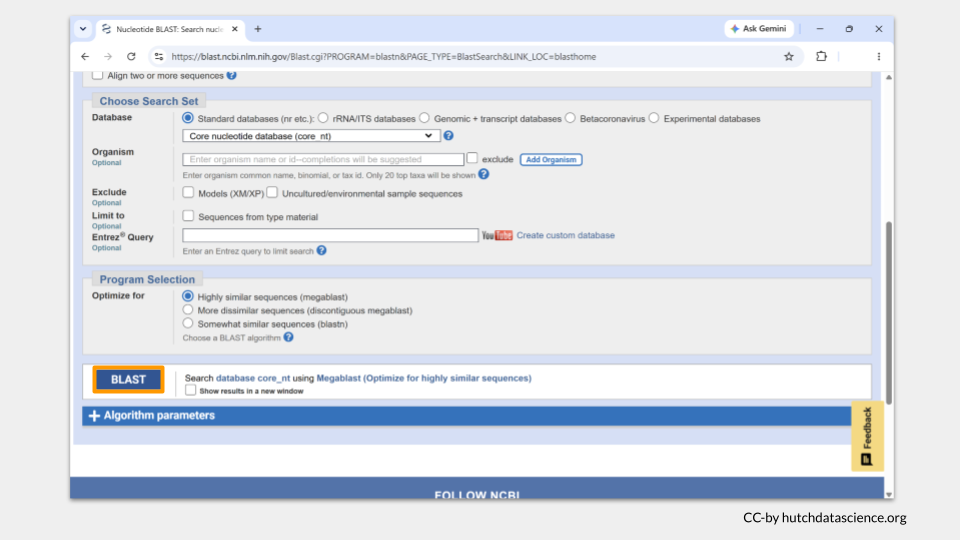
Scroll to the bottom of the page and click the BLAST button.
The browser will take you to a new page while your search is happening. It may take a minute or two for your search to complete, but keep the webpage open.
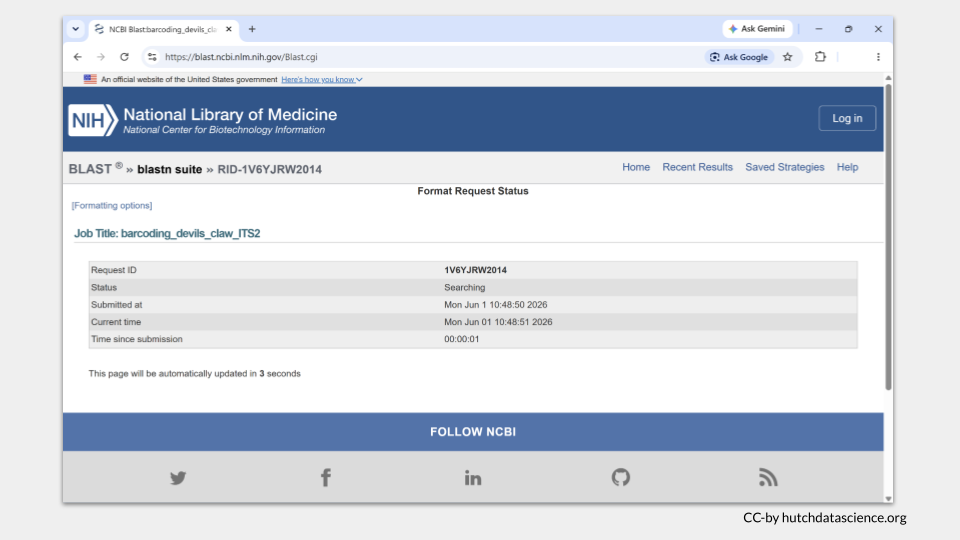
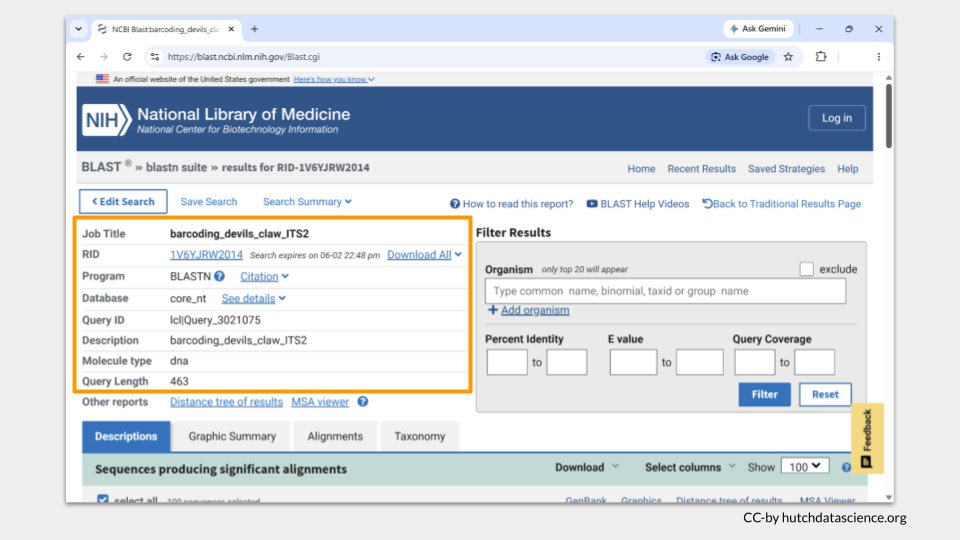
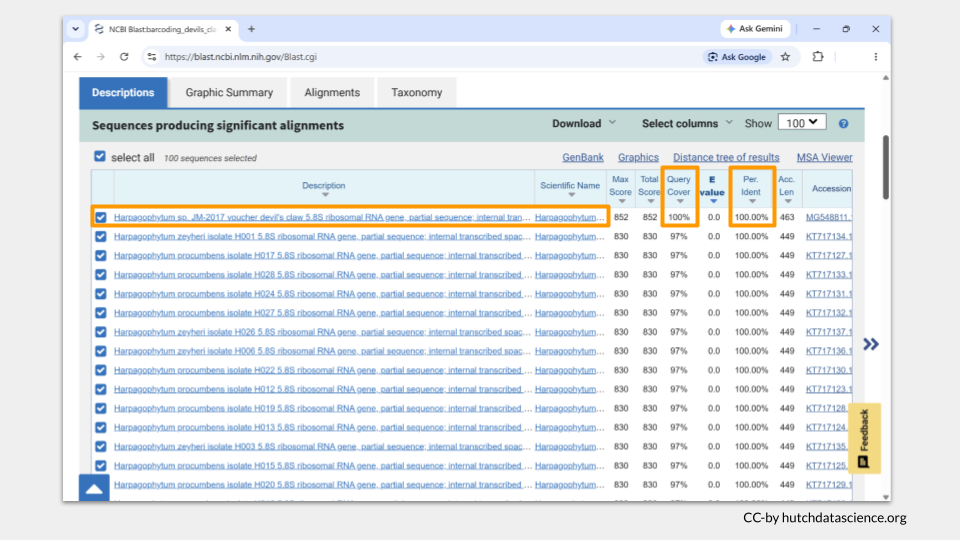
The results page will automatically open. Details about your job are on the top.
As you scroll down, you will see a list of potential reference sequences that match your sample. There are two values in particular that are helpful: query cover (the amount of overlap between your sample sequence and the reference sequence) and percent identity (abbreviated per. ident., the percentage of nucleotides in the sample sequence that match the reference sequence). The best-matching reference sequences will be at the top of the list. GenBank has many reference sequences that are 100% matches to our sample (though only one of the sequences has a 100% overlap, a query cover value in the 90s is still quite high!). According to GenBank, our sample matches both Harpagophytum procumbens and Harpagophytum zeyheri ITS2 barcodes.
TipPart 2: Herbal Medicine Investigation
Following the instructions from the devil’s claw example, do a BLAST search on GenBank to identify the three additional herbal medicine samples, then answer the questions below.
- putative black cumin sample: https://genomicseducation.org/data/barcoding_black_cumin_ITS2.fasta
- putative goat’s head sample: https://genomicseducation.org/data/barcoding_goats_head_ITS2.fasta
- putative epazote sample: https://genomicseducation.org/data/barcoding_epazote_ITS2.fasta
TipPart 2: Suspected Parrot Smuggling
Following the instructions from the devil’s claw example, do a BLAST search on GenBank to identify the three unknown egg samples, then answer the questions below.
The sequences are from the mitochondrial 16S region, which codes a ribosomal RNA. It is an excellent barcoding choice when working with samples that may be degraded or difficult to amplify.
- Unknown egg #1: https://genomicseducation.org/data/barcoding_bird1_16s.fasta
- Unknown egg #2: https://genomicseducation.org/data/barcoding_bird2_16s.fasta
- Unknown egg #3: https://genomicseducation.org/data/barcoding_bird3_16s.fasta
NoteCheck Your Knowledge
Why do you think we got matches to both Harpagophytum procumbens and Harpagophytum zeyheri for our sample?
Answer the following questions based on your case file samples. According to your GenBank search, what is the species identity of your three samples? What are the common names of these species?
What is the percent identity value for the top result of each search?
Do the species identities from the GenBank search match the species identities from the BOLD search?
Answer the question that matches the case file you chose.
Herbal Medicine Investigation Do you think the herbal medicine manufacturers are being truthful in their advertising? If not, would you recommend any regulatory action against them?
Suspected Parrot Smuggling Should the man who was arrested at the airport be prosecuted for parrot smuggling? If so, should he face additional penalties (for attempting to smuggle endangered or migratory species)?